

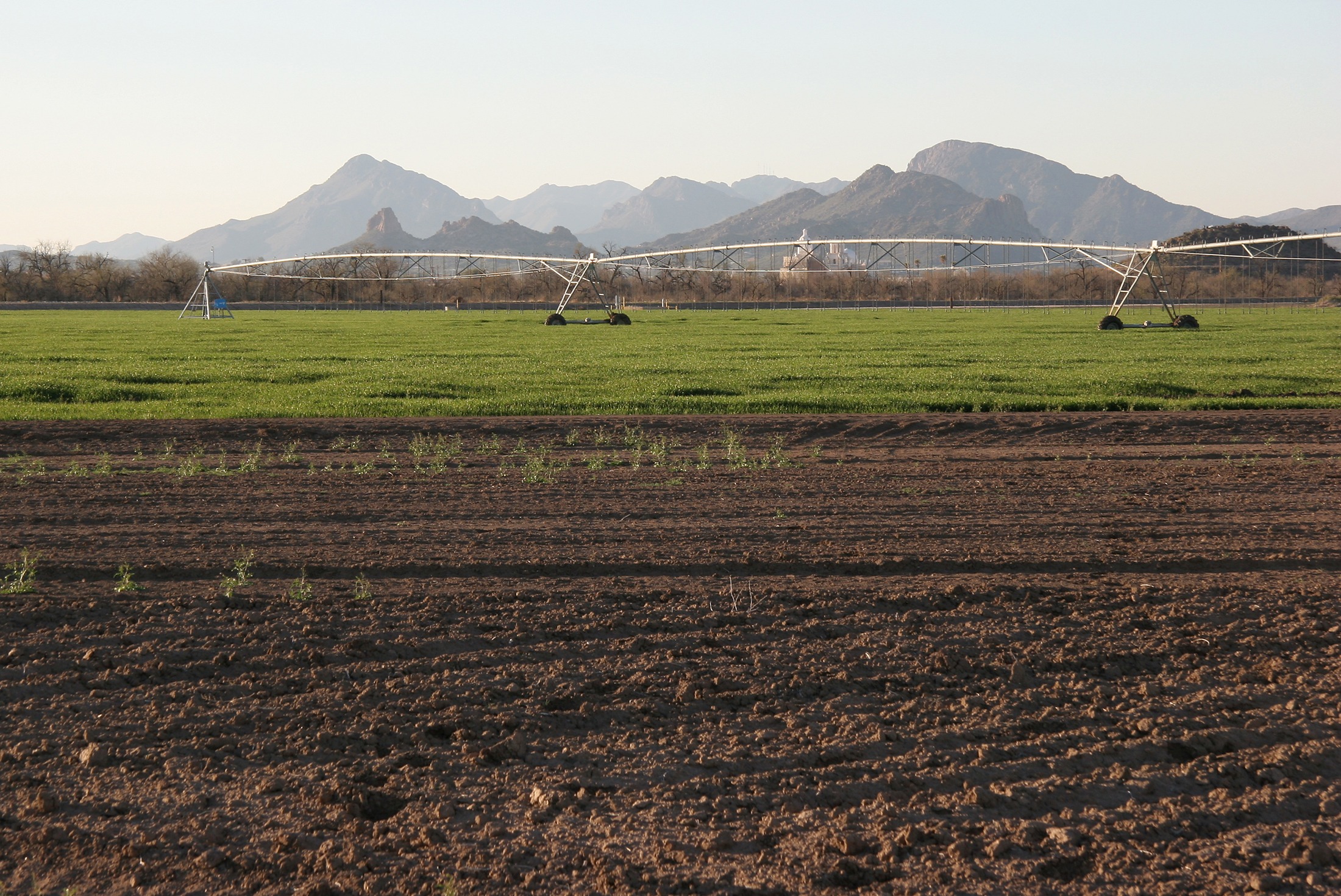
Earlier this month, WestWater Research Senior Associate Audrey Goddard and Associate Amanda Long attended the Arizona Groundwater Policy Conference, where discussions revealed a groundwater landscape in flux—marked by scientific advances, regulatory evolution, and shifting rural attitudes.
GRACE satellite data continues to document Southwest-wide storage declines driven primarily by climate change rather than pumping alone. The conference underscored that Arizona’s challenge goes beyond data availability, as there is also a need to transform robust datasets into policy-ready tools with clear assumptions, reproducibility, and statutory alignment.
A key narrative emerging from the conference was the potential for Active Management Areas (AMAs) to work in rural contexts when properly customized with genuine local input—a notable departure from their historically negative reputation in rural communities.
Success stories from Willcox, where dairies agreed to end double-cropping after community engagement, and from New Mexico’s Pecos Valley, where conjunctive management and water rights retirement prevented interstate priority calls, demonstrated that local leadership and stakeholder collaboration can drive transformative change.
New AMAs require quantifiable, numerical management goals tailored to local circumstances rather than one-size-fits-all approaches.
As Arizona’s water policy agenda remains dominated by Colorado River negotiations in 2026, the conference made clear that rural groundwater issues—from stalled rural policy awaiting the Ranegras Plains decision to emerging data center pressures in places like Coconino County—demand immediate attention and the kind of customized, community-driven solutions that are finally gaining traction across the state.
Arizona Groundwater Policy Conference Summary Key Themes
Groundwater Recharge & Depletion
- Groundwater recharge is not occurring at human-relevant timescales
- GRACE satellite data (since 2002) shows storage changes across the Southwest
- Projected declines are primarily from climate impacts, not just pumping
- Headwaters surface flow is significantly dependent on groundwater contributions
Policy & Regulatory Framework
- Current Groundwater Management Act (GMA) system didn’t fail—boundary conditions changed (hydro disconnect, tribal adjudication, rural gaps)
- Call for federal groundwater policy similar to surface water compacts
- Rural policy stalled 2020–2025; Ranegras Plains decision expected imminently (2026)
- New Active Management Areas (AMAs) need customized approaches—management goals should be quantifiable and numerical, not just safe yield
Data & Modeling Challenges
- Robust datasets still carry significant uncertainty
- Not all data is “policy ready”—needs documentation, reproducibility, clear assumptions, and alignment with statutory definitions
- Uncertainty testing is expensive and time-consuming
- The new Willcox AMA installed 98 monitoring pads; annual data collection is starting this year
Ag-to-Urban Water Transfers
- Designated providers offer holistic management (avoiding end-user fees)
- 1.5 AF/acre allocation debated but represents progress from zero
- Credit application sunsets at 5 years; credit development authority sunsets at 10 years
- Unlikely rural fields convert directly to rooftops—customization needed for subsequent AMAs
Rural & Agricultural Perspectives
- AMAs can work for rural areas with customization and local input. They are not as rigid as their reputation is in rural areas
- Arizona farm production: only ~25–33% stays in-state (90% of fluid milk is local)
- Conservation programs in Douglas (farm-size based) and Willcox (volumetric reductions)
- Success story: Willcox AMA dairies agreed to stop double-cropping after paradigm shift and community engagement from governor.
- Pecan growers strongly support sustainability—100-year crop investment at stake
Local Leadership Examples
- Pecos Valley (NM): Conjunctive management pioneer; purchased/retired water rights to prevent Texas priority call; now major landowner restoring rangeland
- Coconino County: Facing data center pressure (Page sold 500 acres); using 10-year comprehensive plans and multi-stakeholder coordination
- Willcox: Earth fissure warnings visible; transitioning to change-in-storage metrics
Key Takeaways
- Data is abundant but policy-readiness is the gap—clear documentation of assumptions, reproducibility, and statutory alignment is essential
- Rural attitudes toward AMAs are shifting—historically, AMAs had a negative reputation in rural communities, but this conference showed notable optimism that AMAs can work with proper customization and genuine local input
- Community engagement and local leadership is transformative—when the state asked rural stakeholders what would work, progress happened. Industry and large agricultural operations can change practices when properly engaged
- Ag-to-Urban—program aspects were reviewed. It is a mechanism that is available but eligible parties are still thinking about how and if they might use it. So far, it has helped projects that were stalled when the Phoenix groundwater basin status was released.
- Interstate examples provide models—Pecos Valley’s retirement-based conservation offers lessons for Arizona
- Colorado River dominates 2026 agenda—but rural groundwater issues remain unresolved