
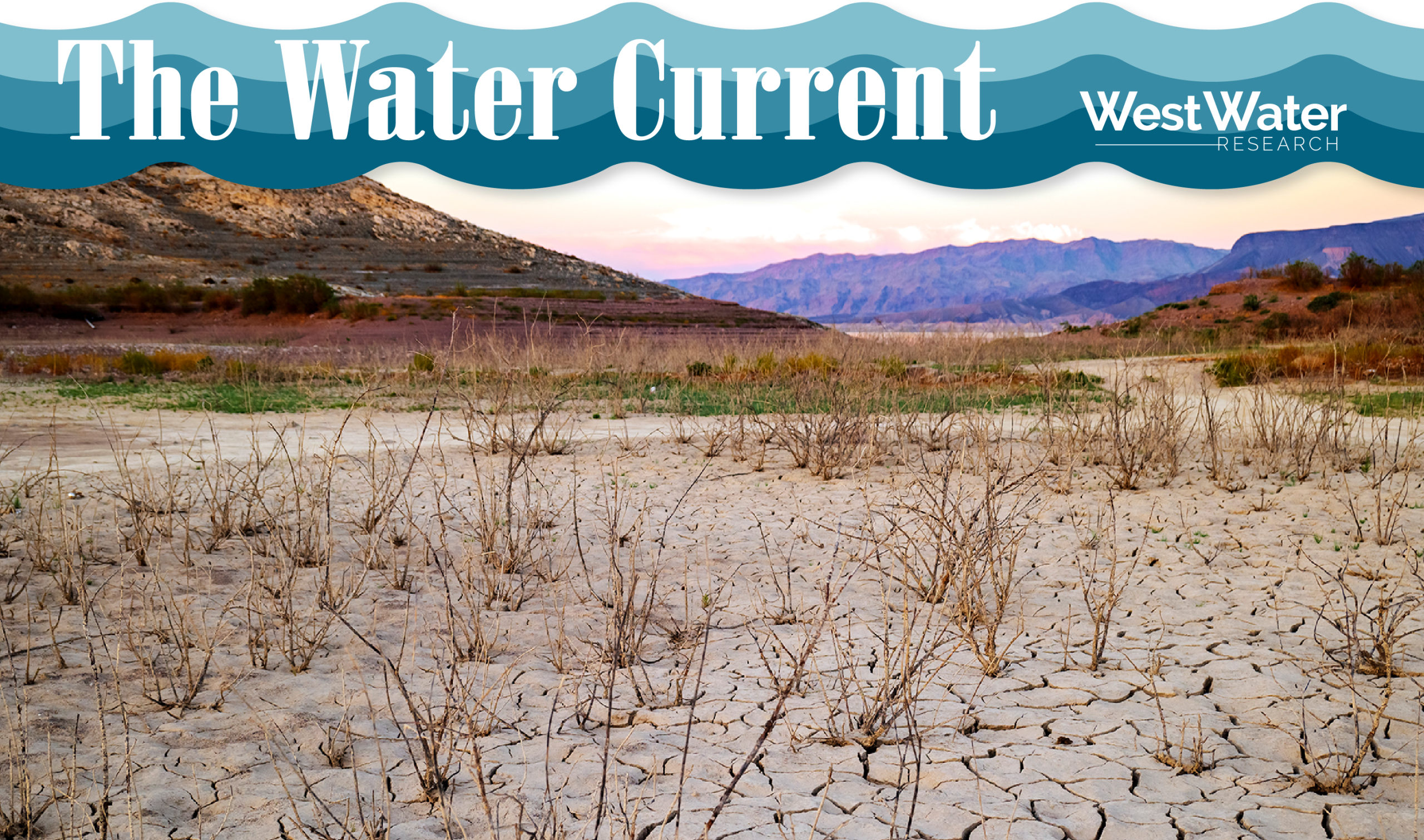
It’s a rough year for water managers in the Western US. The dismal snowpack has resulted in dry creeks, low reservoir storage, and parched soils. The U.S. Drought Monitor shows some level of drought across most of the Western US with exceptionally dry conditions across the Rocky Mountain region from Idaho down to New Mexico. These dry conditions are having several economic impacts that relate to water management:
- Cattle herd sizes are at their lowest levels since 1951 due to operating costs, high beef prices, international competition, and consolidation. Drought is also a major factor that will likely further push herd sizes down as producers struggle to feed their cattle. Low cattle inventory could have an impact on hay prices and irrigated forage production, which is the dominant crop across much of the Rocky Mountain region. Hay prices often rise during droughts, but the response is less clear with reduced cattle numbers.
- Municipal water utilities will likely sell less water to customers this year, partly because they are implementing water use restrictions and staged drought policies that force customers to use less water. These actions are a helpful response to drought to ensure that water is available in future years if drought conditions continue. Most municipal water service costs are fixed, and therefore the only way to reduce water use and balance the budget is to increase rates and/or charge supplemental fees. This was the experienced in California during their last drought and is predicted for several Colorado communities this year.
- Capital investment in water supply reliability will likely be ramped up this year, and in the years that follow, because water managers will be managing through a record low snowpack that may be stressing water systems beyond their design levels. Renewed water supply plans and investments in water supply reliability will follow. Academic research indicates that these capital investments, in response to changing climate, will exacerbate water affordability concerns.
- In some areas of the Western US with active water lease markets, the dry conditions this year will cause demand to rise and supply to fall leading to increased prices for leased water supplies. This has been shown for the California water market during past droughts and the current California water price index is indicating a recent uptick in price.
- Corpus Christi’s near-miss this year is a preview of the razor-thin margins many Western water systems are now operating on. After Lake Corpus Christi hit a record-low ~10% capacity and the city braced for a Level 1 Water Emergency as early as this winter, recent rains pushed that projection out to September 2027 — but Choke Canyon, the region’s largest reservoir, sat nearly untouched at 8% while Lake Corpus Christi rebounded. It’s a reprieve, not a fix, and it underscores the risk for other Western communities counting on rain that may not show up this winter.
…and a whole lot of hope for next year
Given the dry conditions this year, there is a whole lot of hope being built up that a record-setting El Nino event next winter will pile up snow and drop sufficient rain to get us out of drought conditions. Current climate predictions expect elevated precipitation for the southwest U.S. through May 2027. If this prediction turns out to be true, it would represent one of the wildest swings in water availability in the Mountain West seen in recent history, similar to what California experienced from 2021 through 2023. Many water managers will be looking to maximize their ability to use the improved water supply conditions to fill reservoirs and bank water in aquifers. We should all pray that the boy with the water buckets shows up this winter, because another dry winter would severely test our water systems across much of the Western US.
How WestWater can help
Proper planning and strategic implementation of water projects can help to alleviate the impacts of drought on municipal water systems, industrial plants, and agricultural operations. Proper planning involves using up to date datasets and approaches and incorporating financial analysis into water project selection. Strategic implementation involves active communication, organized water acquisition efforts, and staged capital investments. WestWater has helped many clients think about solutions for water supply reliability and assisted them with planning and implementation efforts.