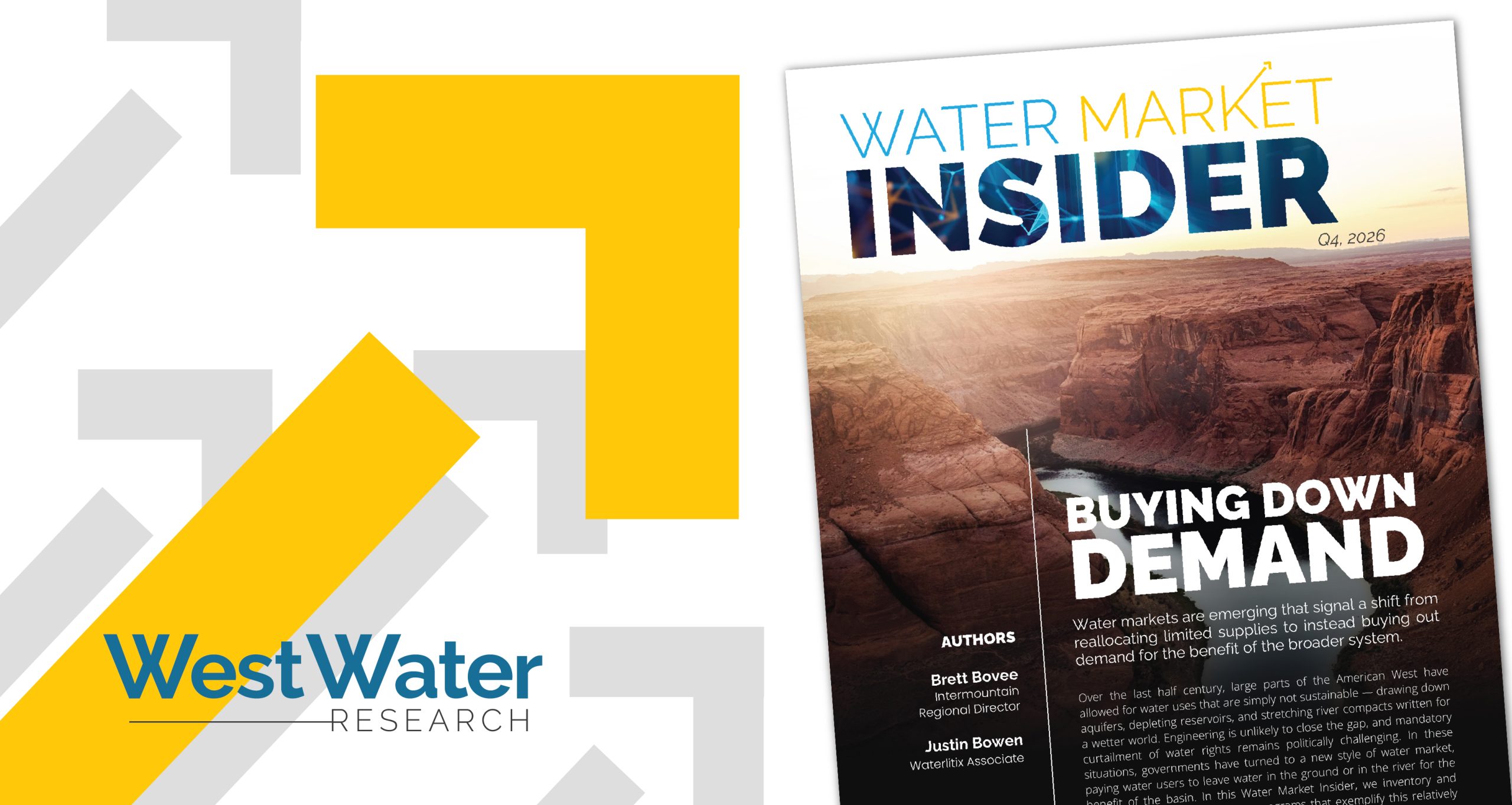
Water markets are emerging that signal a shift from reallocating limited supplies to instead buying out demand for the benefit of the broader system.
Over the last half century, large parts of the American West have allowed for water uses that are simply not sustainable — drawing down aquifers, depleting reservoirs, and stretching river compacts written for a wetter world. Engineering is unlikely to close the gap, and mandatory curtailment of water rights remains politically challenging. In these situations, governments have turned to a new style of water market, paying water users to leave water in the ground or in the river for the benefit of the basin. In this Water Market Insider, we inventory and examine demand management programs that exemplify this relatively new type of water market activity. Whether these programs represent a durable new tool or an expensive stopgap is a defining question for Western water policy in the decade ahead.
Access the full 2026 Q4 Water Market Insider
Enter your email to read the latest issue – you’ll also receive our quarterly publication featuring water market news, insights, and announcements.
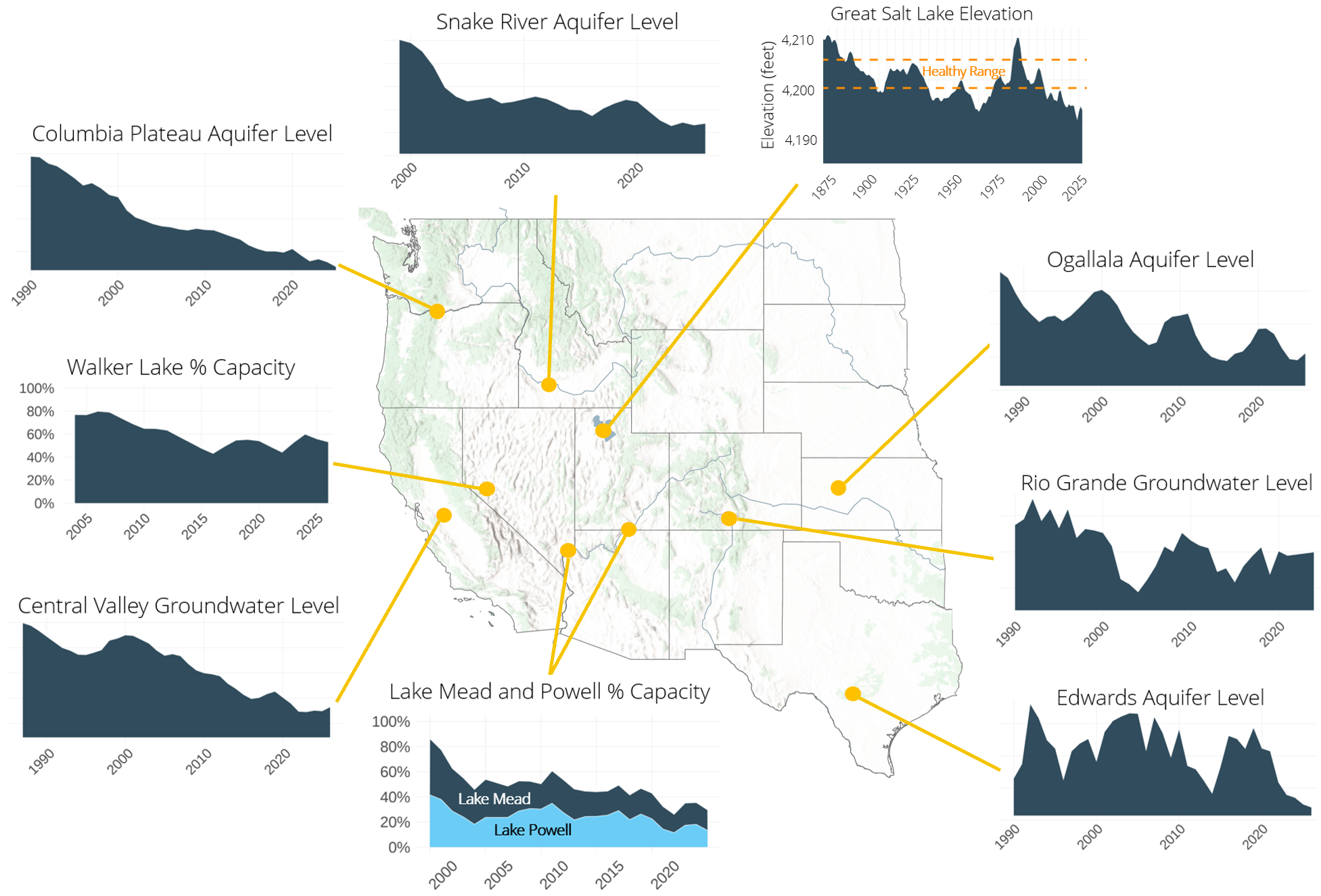
Figure 1: Map of Water Stressed Systems Across the Western US
Supply Creation > Supply Reallocation > Demand Reduction
Water management in the Western U.S. was originally focused on creating and allocating water supplies through water right appropriation and infrastructure development: build a dam, drill a well, dig a canal. Supply development still exists but has shifted toward new (and more expensive) technologies such as desalination, aquifer storage & recovery, and water reuse. As water supply development has slowed, water markets have emerged as a tool to reallocate the existing supply instead of creating new supply. Water markets have traditionally focused on the reallocation of water supplies to new uses through sales and leases. This market activity has fueled the growth of cities, the expansion of agriculture, the development of industry, and the rewetting of depleted rivers. Markets have allowed us to have a degree of flexibility within a fairly rigid water rights system.
A new type of market activity is emerging. Instead of supplying new demand, it removes existing demand to rebalance the system and protect the users who remain. Across water stressed regions of the West, federal, state, and local agencies are building programs that pay water users to forgo use of their entitlements. The goal is to bring use in line with available supplies rather than rely on regulatory measures such as broad curtailments of water rights. Curtailments can be economically disruptive, particularly for municipalities and industry that hold “junior” water rights, which are curtailed first.
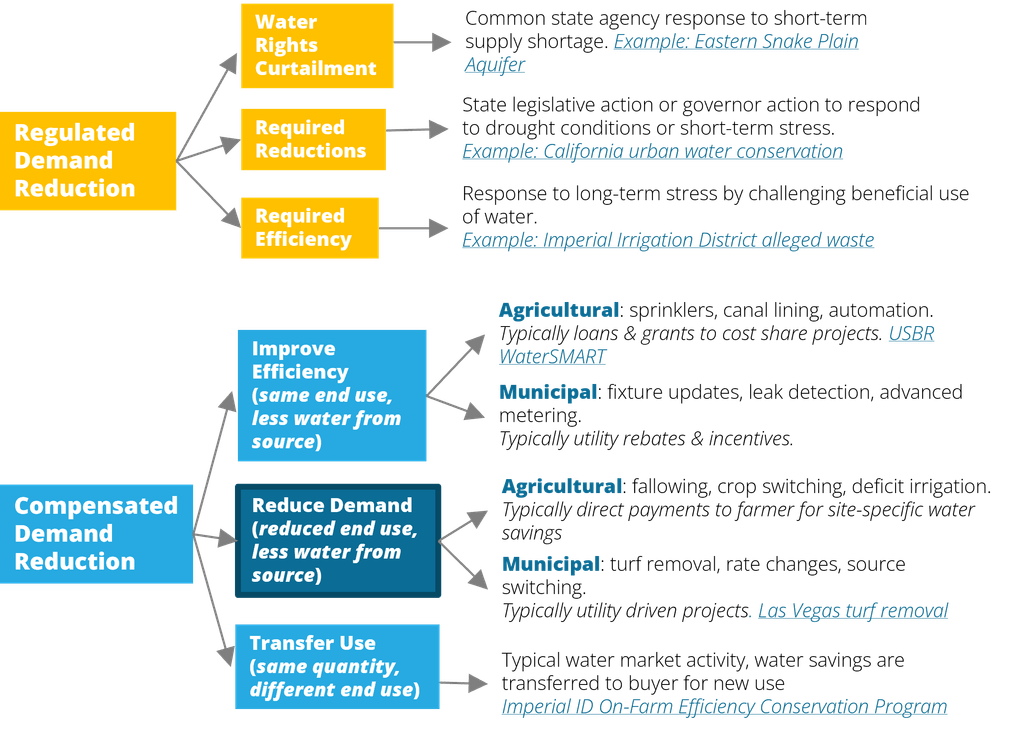
Demand reduction actions fall into several categories (see Figure 2). This Water Market Insider focuses on one: voluntary, compensated reductions in water use that produce measurable conserved consumptive use, benefit the water system as a whole rather than a single buyer, and operate at the scale of a regional river basin.
These categories overlap, and in some cases we used judgment to include or exclude programs with blended characteristics. A compilation of example programs was undertaken, not to be comprehensive, but to look at the characteristics and scale of several large programs operating in the Western U.S. Included are programs that deliver environmental benefits while also serving the system as a whole. Many other environmental water leasing programs were excluded because they do not meet that test.
Figure 2: Types of Demand Reduction Activities
DEMAND MANAGEMENT PROGRAMS
We compiled a dataset of 25 demand management programs across the Western U.S. Demand management programs have a short history in the West, beginning with New Mexico’s Interstate Stream Commission, which started purchasing water rights in the Pecos Basin in 1992 to meet interstate compact obligations. The federally-funded Conservation Reserve Enhancement Program (CREP) — which is not included in the inventory — came next in the early to mid-2000s, addressing stream and aquifer restoration (see p.7), followed by a few larger basin-scale programs starting in the 2010s and 2020s such as the Colorado River system conservation programs, and now emerging state-funded programs at river and groundwater basin scales. These 25 demand management programs have made up a significant portion of the overall Western water market, accounting for 11% of total volume and total value traded since 2010. The selected demand management programs have compensated water users a total of $2.9 billion since 1992, with cumulative water reductions of 16.9 million AF.
Figure 3: Demand Management Programs in Western US
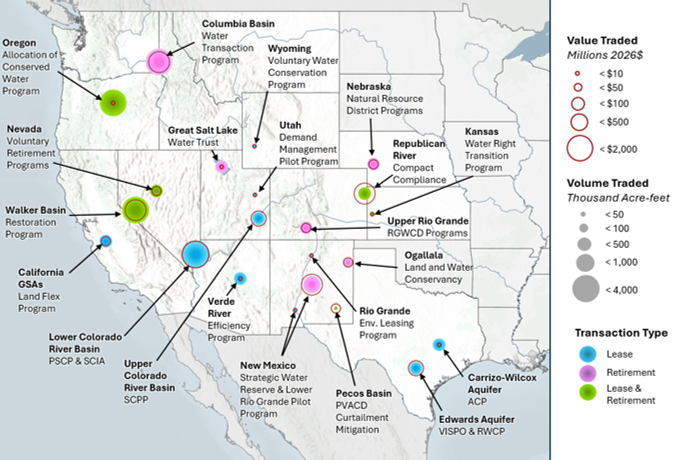
Demand management programs come in several distinct forms, each with different implications for water management, costs, and system balance:
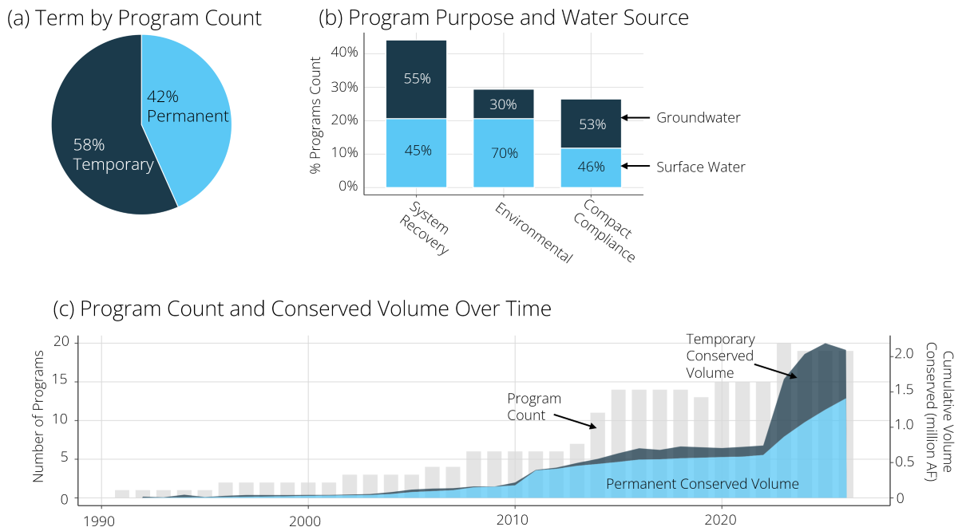
TEMPORARY VS. PERMANENT Temporary lease payments compensate users to forgo their allocations for a season to multiple years, providing immediate system relief without permanently altering water rights. Water right retirement programs, by contrast, compensate users for permanently reducing use of their water rights, removing demand from the system indefinitely. Most programs focus on temporary demand management actions (58% by program count), an approach that doesn’t resolve long-standing water supply imbalances but can be effective in responding to drought.
PROGRAM PURPOSE The driving purpose of all inventoried programs is demand reduction for system-wide benefit. Programs pursue this system benefit to meet interstate compact agreements or avoid curtailment risk, to reverse long-term groundwater and surface water storage decline, or to meet environmental objectives.
Figure 4: Characteristics of Demand Management Programs
LEGAL FRAMEWORK The fragmentation and rigidity of Western water law create a fundamental problem for shepherding conserved water downstream, especially across state boundaries. Many demand management programs fail to change a water right’s nature of use or enforce priority over other users, and thus the water conserved may be at risk of re-diversion by other downstream water users. In few cases, and only in local contexts, have demand management programs succeeded in leveraging state law protections for conserved water.
TIMING & DURATION Of the programs inventoried, the average duration is 10 years, with 82% that are still active and 2 programs in Wyoming and New Mexico that are expected to begin soon. Shorter-duration programs typically respond to immediate environmental or economic concerns through temporary leases, funded through NGOs and emergency federal and state allocations. Longer-duration programs address chronic environmental, economic, and interstate compact compliance concerns, typically backed by robust legislation and state funding that designates an agency to see system balance through to completion. As shown in Figure 4c, most programs have been established in the last 10 years.
PROGRAM CASE STUDIES
USBR’S COLORADO RIVER SYSTEM CONSERVATION PROGRAMS
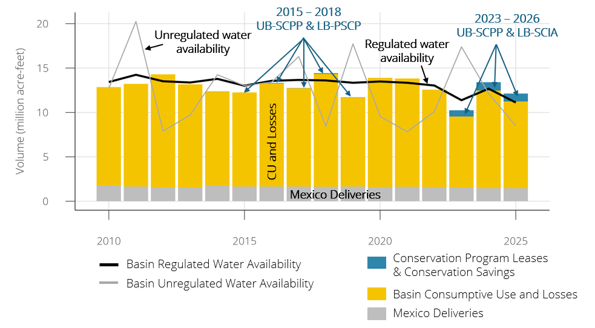
The Bureau of Reclamation’s Colorado River Basin programs established the largest voluntary programs in history, running between 2015 – 2026, which will have compensated water users a total of $2 billion for 3.5 MAF of water savings in an effort to prop up reservoir levels. Despite the monumental effort, the program only reduced consumptive use by 1% to 8% each year, with continued decline in reservoir levels. Current programs will last through 2026, with more funding recently announced to continue this effort.
Figure 5: Colorado River Basin Water Use & Demand Reduction
NEW MEXICO DEMAND MANAGEMENT PROGRAMS
Texas has sued New Mexico three times over interstate delivery shortfalls: twice under the Rio Grande Compact (1950s and 2013) and once under the Pecos River Compact (1974). A 2003 ESA biological opinion also imposed required flows on the Rio Grande for listed threatened and endangered species. New Mexico’s Interstate Stream Commission (ISC) meets these obligations mainly by purchasing water rights for retirement, supplemented by leases—spending roughly $83 million in the Pecos Basin, an anticipated $150+ million in the Rio Grande Basin, and $2 million for ESA compliance. The Pecos River effort is considered a success, and Rio Grande efforts are expected to follow suit. Local agencies, including the Pecos Valley Artesian Conservancy District and the Ogallala Land and Water Conservancy, have adopted a similar model, prioritizing purchases over leases to offset junior-right depletions.
RELATED FEDERAL PROGRAMS
CONSERVATION RESERVE ENHANCEMENT PROGRAM (CREP) & THE WATER-SAVING COMMODITIES PROGRAM
Two federal programs fall outside the 25-program inventory but have contributed to demand reduction indirectly.
CREP is a federal-state partnership program focused on addressing agricultural environmental problems across 26 states. Of the 45 programs, 6 implemented voluntary land fallowing and retirement to address mostly groundwater overdraft concerns. Water-focused CREP projects began in Nebraska in 2005 and now operate in Kansas, Colorado, Idaho, and Oregon, spending $880M and conserving approximately 2.8M AF.
USDA’s new Water-Saving Commodities Program (announced 2024) is investing up to $400M across 18+ western irrigation districts, plus $45M for Tribal projects, to fund water-saving technologies and practices while keeping land in production. The program is targeting 50,000 AF saved across 250,000 acres.

INTERNATIONAL PERSPECTIVE
DEMAND MANAGEMENT IN AUSTRALIA’S MURRAY-DARLING BASIN
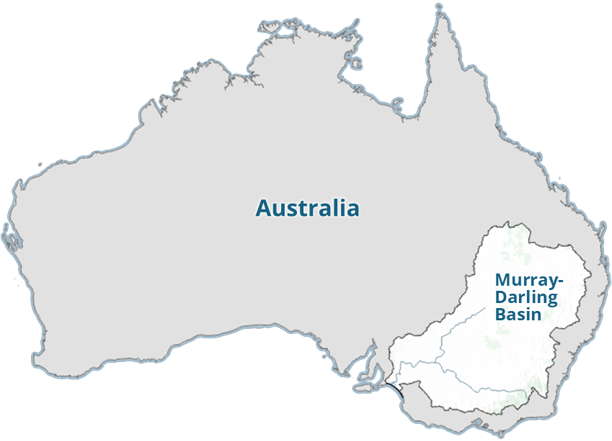
Australia’s large-scale demand management program in the Murray-Darling Basin (MDB) offers an instructive case study of a largely successful initiative that ultimately succumbed to political pressure. This example provides valuable insights into the conditions that enable demand management programs to succeed, as well as the political opposition that inevitably emerges to contest control over a program’s core objectives.
A century of subsidized irrigation expansion left the river system massively overallocated, with environmental flows so degraded that 20 of 23 catchments were assessed in poor or very poor ecological condition. In 2012, the government established binding Sustainable Diversion Limits and set a target of recovering 2.23 MAF of surface water consumptive use for the environment, one of the largest planned water reallocations in history. Over $9.1B (USD) was committed to the effort, of which $7.2B (USD) was directed to two recovery instruments: (1) direct voluntary buybacks of water entitlements from willing sellers through an open competitive bidding process, and (2) subsidized irrigation infrastructure upgrades in exchange for surrendered water savings.1
1 Comparing the success and failure of the Murray–Darling Basin Plan’s water recovery programs – Wheeler – Australian Journal of Public Administration – Wiley Online Library
DEMAND MANAGEMENT IN AUSTRALIA’S MURRAY-DARLING BASIN
Recovered water was permanently transferred to the Commonwealth Environmental Water Holder, an institutional structure with no parallel in the United States. However, the Commonwealth was swayed by the irrigation lobby in 2015 to cap cost-effective buybacks at 1.2 MAF, forcing a costly shift to infrastructure programs (~$5,700/AF for infrastructure projects vs. ~$1,800/AF for buybacks) that produced a rebound effect in water consumption: upgraded farms increased their water use by 10% to 50%.² Separately, in 2018, the recovery target was lowered to 1.68 MAF through legislation which credited infrastructure and environmental management projects in place of some of the water originally slated for recovery. By June of 2026, the program recovered 1.68 MAF, meeting its (reduced) target demand reduction, but at far greater cost than the original buyback-driven approach would have achieved.
Western U.S. programs share the same basic logic, paying users not to use water, but are assembled atop a fractured system of state water right laws and interstate compacts. Many of the compiled demand management programs lack an open and competitive bidding structure, and price transparency, that made MDB participation broad and effective. Also, where Australia built a permanent institution backed by long-term appropriations, Western programs are largely funded through short-term emergency allocations, environmental organizations, or local agencies with only a few examples of durable financing mechanisms put in place. The MDB’s hard-won lesson for the American West is that demand management programs built on crisis appropriations rather than permanent institutions are acutely vulnerable to the political capture and discontinuity that turned Australia’s most cost-effective policy tool into a decade-long stalemate.
2 Recovering water for the environment in the Murray-Darling: farm upgrades increase water prices more than buybacks
OBSERVATIONS: DEMAND MANAGEMENT PROGRAMS
- 1. DON’T CHASE A “MAGIC” PRICE POINT
Water conservation programs must adapt to water and market conditions each year and motivating participation is an uncertain objective that requires flexibility & feedback. These agreements involve deal making.
- 2. PRICE TRANSPARENCY BUILDS TRUST AND TRUST IS KEY
Demand management programs often involve dozens of water users (or more), and nobody wants to feel uncertain that they did not get a good deal compared to their neighbor. Agencies need to be transparent about pricing to build trust, which is difficult because sometimes not all water rights are created equal in terms of demand management benefits.
- 3. REDUCED CONSUMPTIVE USE IS HARD, MUCH HARDER THAN REDUCING “WATER USE”
Our water systems have slack by design. It’s easier to become efficient and reduce losses. Reducing consumptive use often means reduced yield and income, and involves harder decisions.
- 4. DEMAND MANAGEMENT PROGRAMS WILL BE UNPOPULAR AND WILL RECEIVE POLITICAL PUSHBACK
The lesson of the Murray-Darling Basin is instructive and should be expected in the Western U.S. where demand management programs are initiated without collective buy-in from water users.
- 5. WATER SUPPLY RISK CAN BE MORE MOTIVATING THAN MONEY
Water users faced with water supply risk will be motivated to take reductions that money alone would not entice. This is true for agricultural & municipal water users. Communicating water supply risks and risk avoidance is a necessary part of getting participation.
- 6. ACHIEVING CONSERVATION GOALS TAKES LOTS OF TIME & MONEY – MORE THAN YOU THINK
The examples show that success takes longer than anticipated and requires sustained funding over many years. There are no examples of a program achieving its objectives on time and within the original budget.
- 7. REGULATORY BOUNDARIES CAN DRIVE DESIRED OUTCOMES
Market economics are important to recognize but “free market” water management is often not desired. It is important to set up the rules to achieve the outcomes you want and prevent the outcomes you don’t want.
CONCLUSION
Many parts of the Western United States are at an inflection point in water supply security. These areas are increasingly in need of strategies to rebalance systems that engineering and mandatory curtailment cannot or will not fix. In these stressed regions, water market activity focused on compensated demand management is likely to see continued growth. The programs reviewed in this Water Market Insider reflect genuine progress but remain fragile instruments that are largely built on emergency funding and short-term policies. The Australian experience makes clear that permanent institutions, durable financing, and political will are often needed to sustain demand management programs and achieve targeted objectives. The existing demand management programs provide informative case-studies and instructive lessons to stakeholders at all levels of government in the planning, design, and implementation of new programs.
FURTHER READING ON WATER MARKETS
For additional insight into regional water market trends, pricing dynamics, and emerging markets, WestWater Research publishes the WATER MARKET INSIDER — a quarterly report delivering timely analysis across western water markets. Each edition dives into a market theme, highlighting market-moving events and keeping our water community updated on a rapidly evolving market.
CONTACT THE AUTHORS
Brett Bovee
Intermountain Regional Director
Colorado Office (970) 672-1811
bovee@westwaterresearch.com
Justin Bowen
Waterlitix Associate
Colorado Office (970) 672-1811
bowen@westwaterresearch.com

HOW WESTWATER CAN HELP
Designing a demand management program that delivers real conserved consumptive use takes more than funding. WestWater Research helps agencies, utilities, NGOs, and water users plan, price, and implement compensated demand reduction programs across the western U.S. We draw on Waterlitix™, the largest pricing database for western water transactions, to set compensation that is defensible, transparent, and responsive to changing market and hydrologic conditions. Our team evaluates which water rights deliver the greatest system benefit, structures lease and retirement agreements, and supports outreach and negotiation with participating water users.
