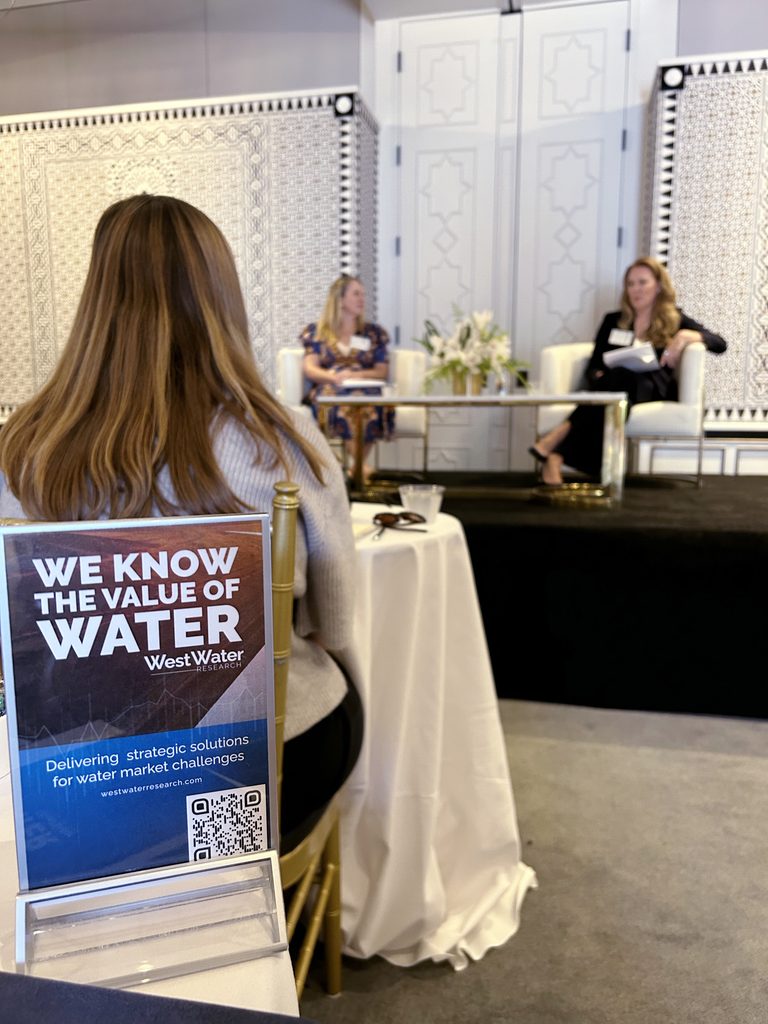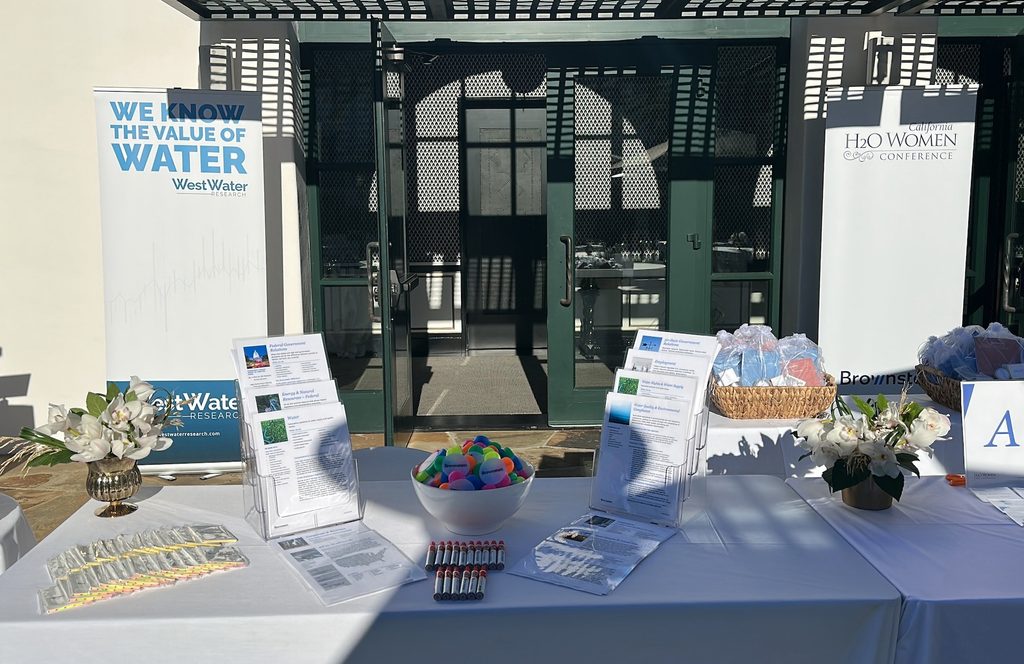
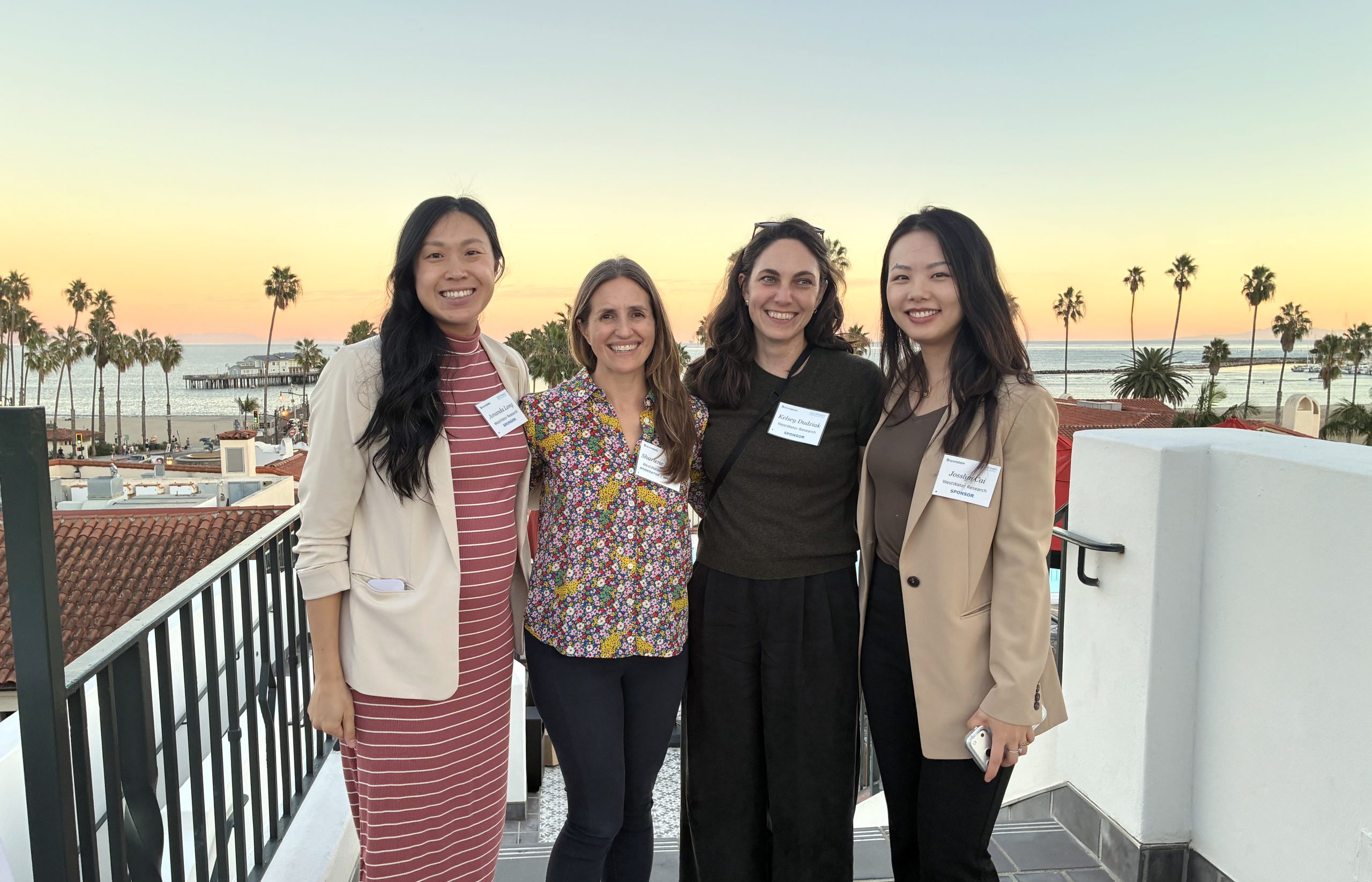
Earlier this month, WestWater’s Amanda Long, Josslyn Cai, Kelsey Dudziak, and Sharlene Leurig attended the 2026 H2O Women Conference in Santa Barbara, California, where WestWater was proud to serve as top sponsor. Our team works across the western U.S., and the conference was a chance to step outside our familiar markets and pick up new insights. Panels covered a wide range of market, financial, and policy questions. Several themes stood out.
De-Risking Water Innovation
Many promising water technologies stall between early funding and full adoption. The private sector is helping close that gap. Early-stage investors back new ideas, growth investors help them scale, and established companies acquire proven products and stand behind their performance. That backing matters. Utilities need assurance a product will work, and most startups can’t offer the warranties that provide it. Each player absorbs a different share of the risk, giving utilities a clearer path to adoption. Paid pilots strengthen that path further, since a trial someone pays for signals real value to both utilities and investors.
Policy Tools Water Lacks
Water lacks policy tools that other utility sectors rely on. Renewables attracted capital through predictable, contracted cash flows enhanced by federal tax credits. Power customers have had federal bill assistance for more than 40 years, while water’s equivalent was a temporary pandemic-era program that has since ended. Part of the gap is structural: water is mostly publicly owned, and some states limit using rate revenue to subsidize low-income customers. Closing it could make water both more investable and more affordable.
The Cost of Waiting for Funding
Waiting for funding has a price. Federal and state grants and loans can take years to award, and many utilities delay projects until that money arrives. Construction costs keep rising in the meantime. Speakers noted that the delay can add millions to a project’s original cost, sometimes eroding much of the value of the funding itself.
Workforce as a Constraint on New Supply
Discussions of new water supply tend to focus on technology, cost, and regulation. Workforce gets less attention, but it may matter just as much. The water sector faces a widespread shortage of qualified operators, and EPA estimates roughly one-third of the water workforce is nearing retirement age. Direct potable reuse (DPR) shows how this can stall progress. California’s DPR regulations require a top-certified operator on site 24/7, plus more stringent monitoring than conventional treatment. As water supplies grow more complex, the people needed to run them will help set the pace of what gets built.
Trust Matters as Much as Technical Detail
Water transfers run on speed. A delivery that arrives after a critical crop stage can cost a farmer the season, and approval and paperwork often take longer than that window allows. Today, trust and long-standing relationships close the gap. Speakers noted that this works but does not scale. Deeper markets and streamlined regulation could deliver the same speed to buyers and sellers who lack those relationships.
Sharlene Leurig, WestWater’s Texas Regional Director, moderated the panel “What it Takes to Move Water: Building Systems, Infrastructure and Trust.” She noted the caliber of the room.
“It was an inspiring group of women leaders in water. Some are representing their states in complex negotiations. Others are running water utilities or investing in next-generation technology and business models,” Leurig said. “It was a welcome balance of technical discussion and real conversation around trust, a topic that doesn’t come up at most water conferences.”
Key Takeaway
Overall, the conference was a reminder that a career in water offers endless opportunities to learn, whether in a new subject or one you thought you knew well. Many of these challenges come down to how water is valued, financed, and moved. Solving them will take collaboration across markets, utilities, and policymakers.
We look forward to continuing the conversations at the 2027 Sustainable Water Investment Summit, March 4–5 at Terranea Resort. WestWater co-produces SWIS with Brownstein Hyatt Farber Schreck, bringing together investors, water users, and policymakers to explore the business of water. Learn more at sustainablewaterinvestment.com